Reimagining Fiber: Minimalism, Memory, and Sustainability with Sandra Junele
Cami Smith
| Artist Feature
Multi-award-winning textile artist Sandra Junele works out of her studio in Dundee, Scotland, where she turns discarded fibers into minimalist wall panels and installations. With a background in interior and textile design, she developed her own plant-based binder that enables her to transform recycled textile waste into sculptural forms. Her pieces are not only beautiful but also endlessly reusable—submerge them in water, and the material can be reshaped again.
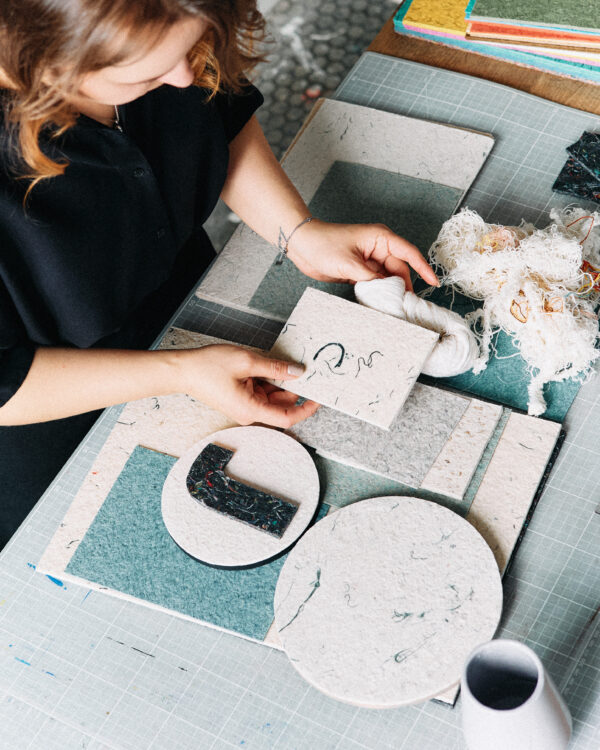
Sandra Junele in her studio. Photo credit for all images: Inga Gromiko
For Junele, materials are always the starting point. She works exclusively with natural textile waste and her handmade binder. These built-in constraints guide her process, making minimalism feel natural. Instead of overwhelming with detail, she emphasizes the essential—texture, depth, and the quiet dialogue between colors.
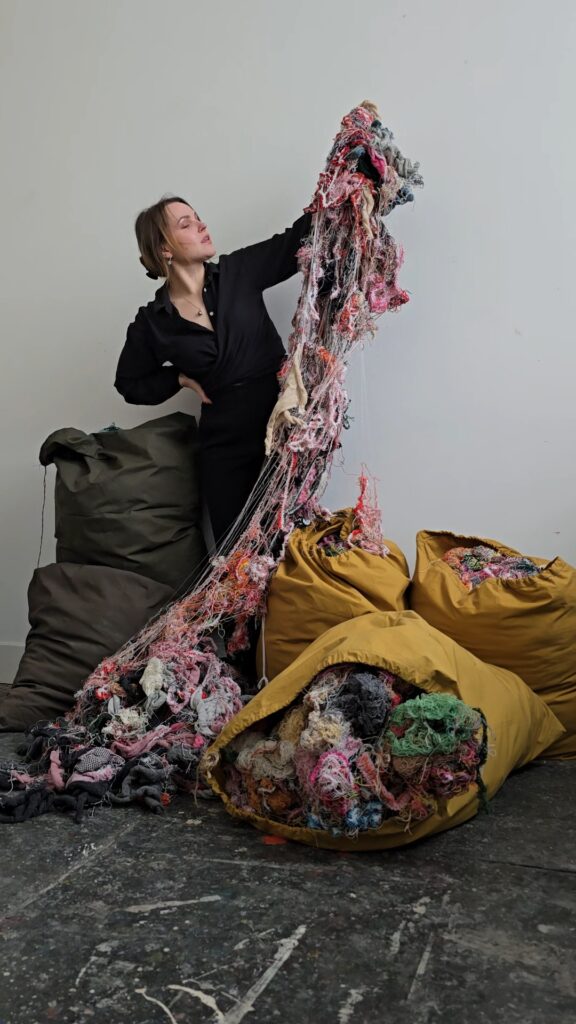
The making itself is slow and hands-on. Junele begins by collecting offcuts and yarn waste from local manufacturers. Each batch is sorted by color, with any synthetic fibers removed from the batch. Once the fibers are ready, she shreds them and prepares her binder. The mixture is spread into flat sheets, dried until firm, then cut into shapes and layered onto wooden frames. It’s deliberate work, and Junele embraces the pace: “It’s exactly what makes each piece unique,” she said.
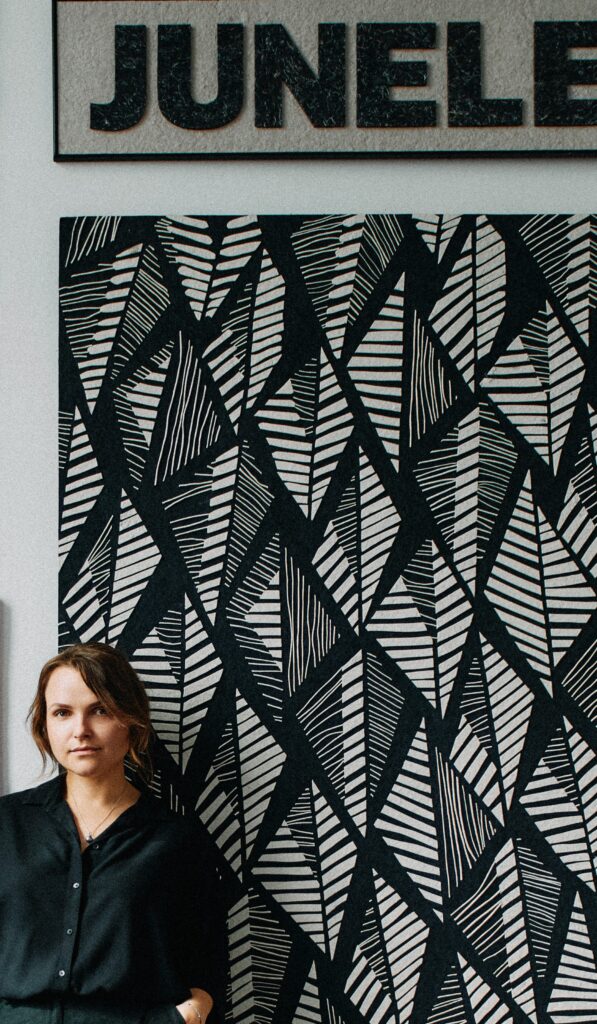
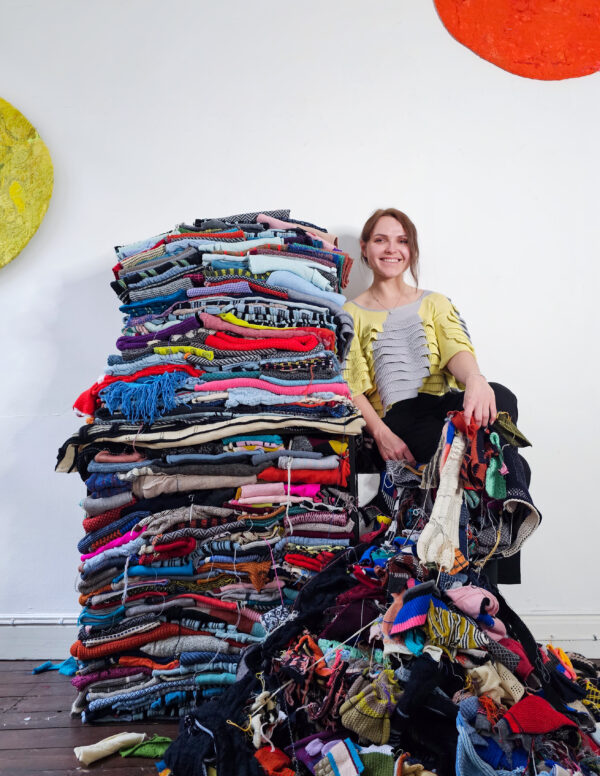
Sandra Junele in the studio in front of her artwork. 2023; wool waste mixture, organic glue, wooden frame; bonded, attached; 63 x 43.75 x 1.5 in.
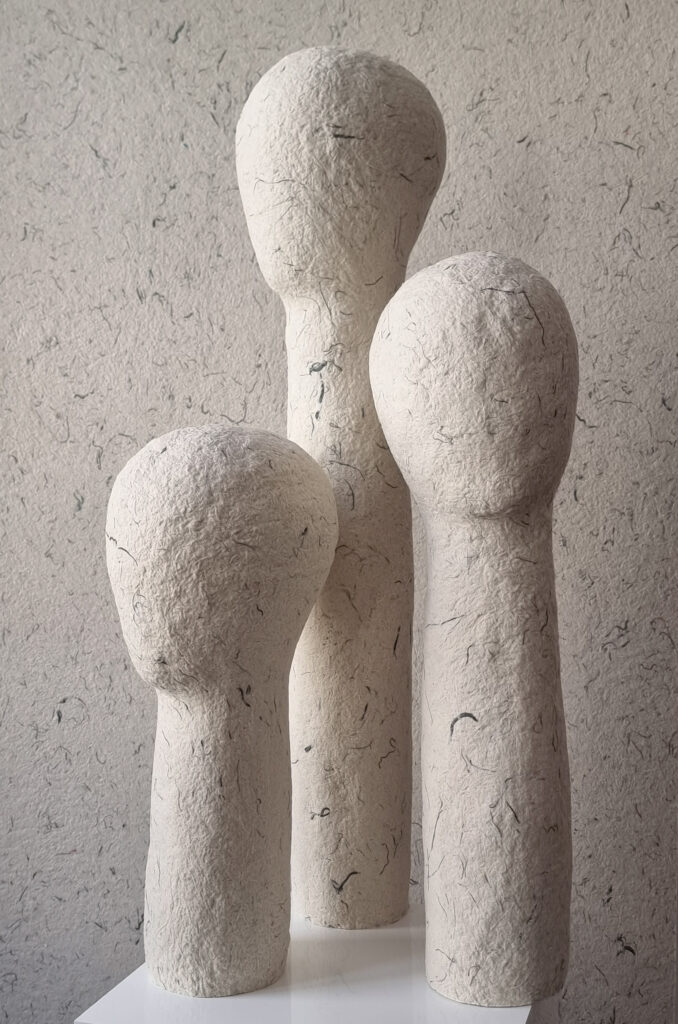
Mannequin heads made from wool and cotton bonded with her organic plant-based binder.
Her commitment to reuse is rooted in her childhood in Latvia. Surrounded by makers and teachers, she was especially influenced by her grandfather, who could repurpose anything. He built furniture from fallen wood and even tractors from spare parts, all in a tiny, chaotic workshop. “He taught me to recognize possibility in overlooked materials and to make with care and resourcefulness,” said Junele. This philosophy continues to shape her practice. Sustainability feels less like a choice and more like the natural way she learned to create.
Working with recycled fibers isn’t without challenges. Large bags of tangled yarn require hours of sorting, and the unpredictable supply of colors means she sometimes waits years to collect enough for a single shade. Instead of frustrations, these tasks have become opportunities for growth. Sorting has turned into a form of meditation, while scarcity has taught her to plan carefully. “Measure seven times, cut once” is her rule. Another hurdle she encountered was perception—some initially mistook her pieces for papier-mâché or felt. The solution was to show more of her process. By sharing videos of her work in progress, Junele helps audiences connect with the story and labor behind each piece.
Sandra Junele in her studio.
For those inspired to try Junele’s technique, her advice is simple: start small, stay playful, and work only with what you already have. Reuse fabric scraps by layering, sewing, folding, or tearing them apart. Let curiosity lead the way. “That’s exactly how I started,” she said. For those ready to explore further, Junele offers binder kits in her Etsy shop, with the same plant-based binder she uses in her projects.
Through her thoughtful process and inventive techniques, Sandra Junele shows how waste can be transformed into objects of beauty, depth, and meaning—art that is sustainable not just in its materials but in its philosophy.