When Holly Wong says her practice is about “radical repair,” she means it in the most literal sense, stitching things together, cutting them apart, and stitching them back together again until the fracture becomes the structure. Wong, a Presidential Scholar in the Arts represented by galleries in four cities, creates fiber and drawing-based installations shown in more than 100 exhibitions, all asking the same essential question: What can be made from the broken things we carry?
Wong’s studio is in a spare bedroom in her San Francisco home, and every morning begins at 3:00 a.m., before the house wakes, before the rest of life makes its demands. Drawing is always at the center. It’s where everything begins. But when an idea needs a different kind of intelligence, she lets the materials lead. Aluminum receives collaged paintings with a particular permanence, its shaped edges pushing the work out into space. Fiber does the opposite; it suspends, filters light, and shifts depending on where you stand. “When I know I need to conjure something rather than declare it,” she said, “that’s when I reach for tulle and thread.” Her westward-facing studio window delivers long afternoon light that often tells her exactly which material a piece needs to become.
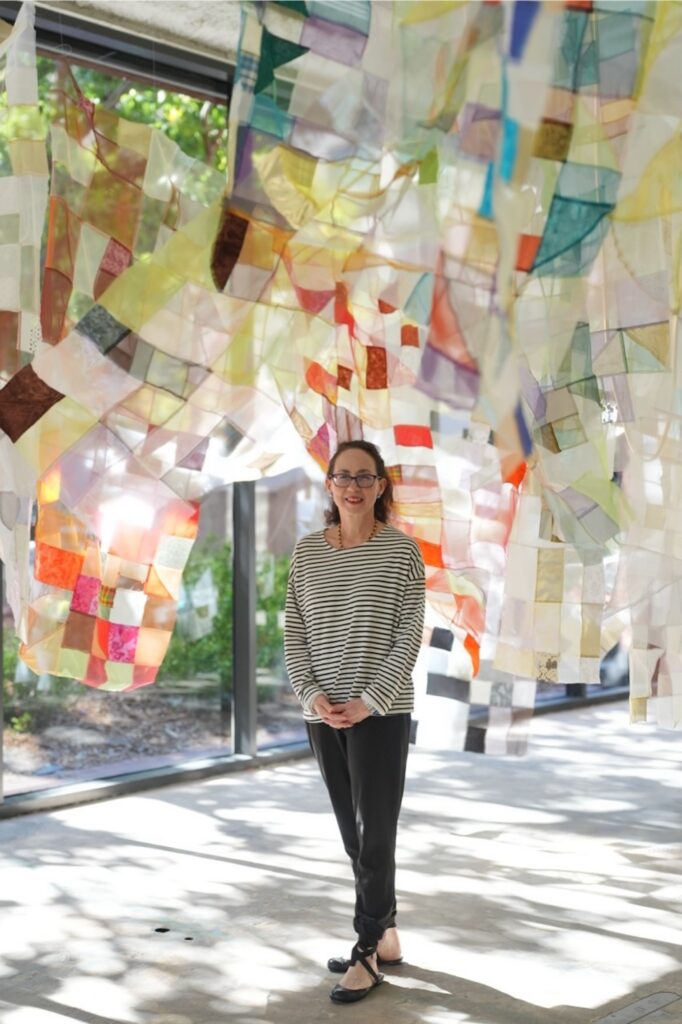
Holly Wong with Mending Light; 2025; silk, cotton, organza, antique lace, netting, LED lighting; cut, machine-stitched into layered sections, attached to aircraft cable suspended across the space, LED lights are woven through the layers in a continuous flowing rope form and diffused by the translucent and lace-patterned fabric; 84 x 144 x 420 in. Photo credit: Zabrina Deng.
Lethe, Mnemosyne, Thalassa. Wong says these figures found her, the way the ocean does, entering “whether I invite it or not.” When personal trauma came in fragments rather than a coherent story, myth became the container large enough to hold it. Lethe, the river of forgetting, she once read only as loss but has come to see it as a necessary mercy. Her counterpart, Mnemosyne, goddess of memory and mother of the Muses, pulls in the opposite direction. That tension between remembering and forgetting, holding and releasing, is, Wong said, “the entire terrain of her practice.” The sea deities arrived because she hears the fog horns from her studio, the Pacific Ocean insisting on being part of the work. “The aquatic world is formless, constantly in motion, and yet it carries tremendous force. I find that’s a good description of grief, of beauty, of most things worth making art about,” she said.
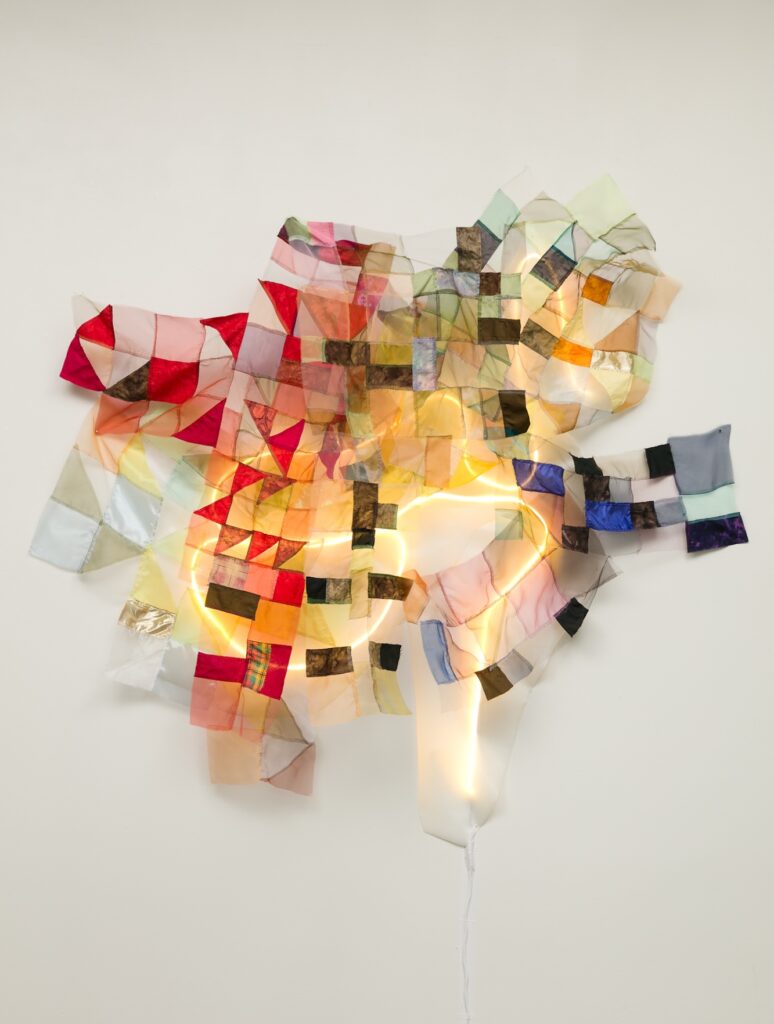
Deconstructed Quilt 2; 2022; silk, cotton, organza, monofilament wire, LED lighting, photo diffusion film; cut, pieced, machine stitched, assembled, suspended from the wall and ceiling, LED lighting threaded through/between the layers (LEDs are covered with photo diffusion film, softening the light); 60 x 60 x 18 in. This piece was inspired by Korean Bojagi patchwork traditions. Photo credit: Wes Magyar
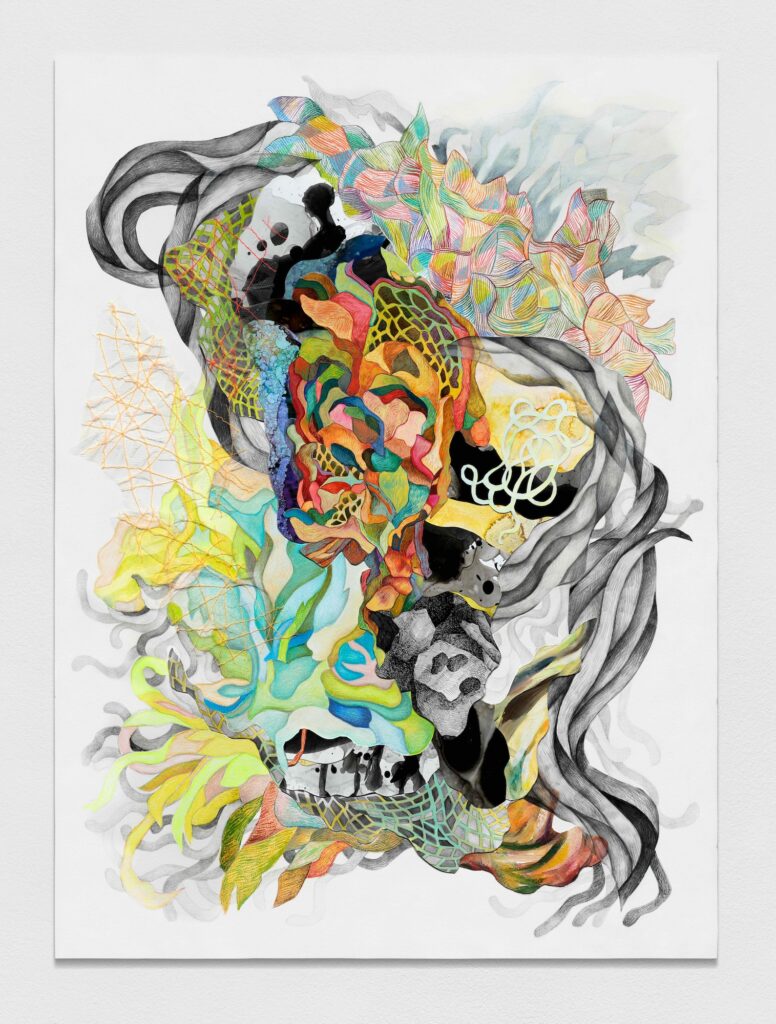
Lethe’s Garden 2; 2025; graphite, colored pencil, gouache, oil paint, alcohol ink, fabric on paper; drawn, painted, mark making, glued, collaged; 30 x 22 in. Photo credit: John Janca
Material choices further reinforce this responsibility to history. Kerry-Harlan works with textiles that already carry meaning: vintage lace from her grandmother’s dress, an antique quilt made by an unknown relative, fabrics depicting Black women picking cotton. These elements are not decorative; they are witnesses. Together, her abstractions and Mazloomi’s figurative narratives demonstrate that storytelling in fiber can be both explicit and implied—equally truthful, equally powerful.
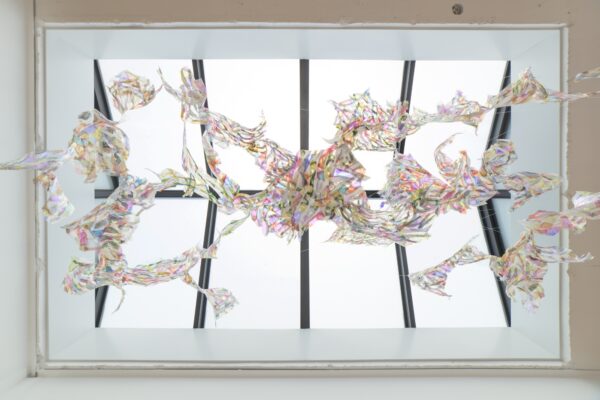
Spell Tapestry; 2025; dichroic film, drafting film, silk, cellophane, thread; cut, layered, machine sewn then cut again and sewn again; 48 x 108 x 168 in. Approximately 15 modules are suspended from the ceiling using small suction cups. Individual modules are linked to one another across the space using a fabric tack gun. Photo credit: Light42 Studio
In her piece Spell Tapestry, the work was stitched, then sliced, then stitched back into itself. “It has what I’d call a fractured kaleidoscope quality,” Wong said, “but every fracture is also a suture.” That is what radical repair means to her: not that the wound disappears, but that it becomes part of the structure. “The little broken things become, through accumulation and attention, a big coherent thing.” The repetition of stitching, cutting, and layering carries its own meditative quality. She said the studio is where she processes what she can’t always say in words.
When someone steps into one of Wong’s installations, she hopes they feel permission to slow down, to stay with something unresolved. Having grown up in a household marked by violence and loss, for a long time she believed beauty wasn’t available to her. Her practice has become her own evidence that it is. “If someone steps into one of my rooms and feels that broken things can become whole,” she said, “then the piece has done what I needed it to do.”
Holly Wong is represented by SLATE Contemporary Gallery in Oakland, California; Bridgette Mayer Gallery in Philadelphia, Pennsylvania; ELLIO Fine Art in Houston, Texas; and Walker Fine Art in Denver, Colorado.
hollywongart.com | @hollywongart
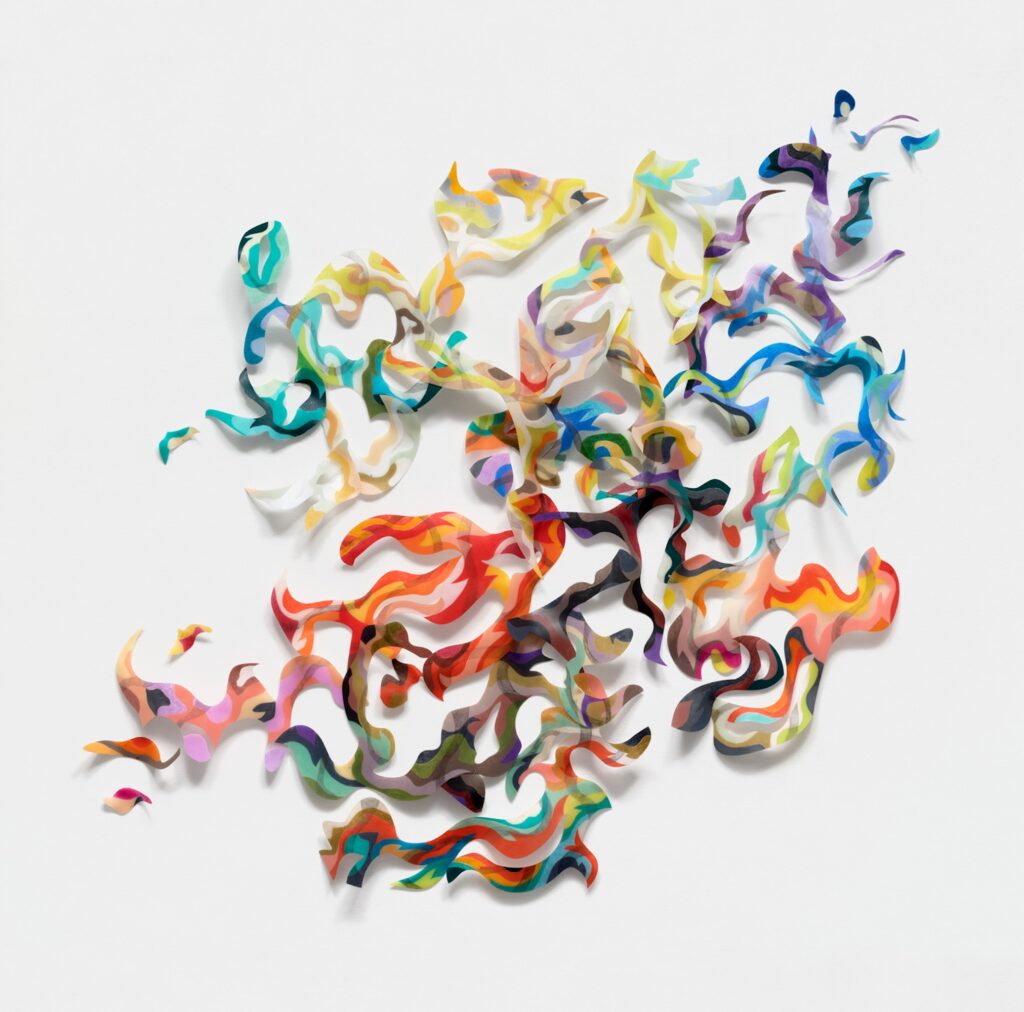
Thalassa; 2025; lightfast colored pencil, graphite on acrylic, heat gun, monofilament wire, finishing nails; vector-drawn by hand, CNC cut, heat molded, cooled (into final three-dimensional configurations), drilled, hand sewn into modules, wall mounted; 58 x 55 x 4 in. Photo credit: John Janca
Cami Smith is the Fiber Art Now media manager, community engagement coordinator, and a mixed-media artist.