Out and About: Celebrating the Work and Friendship of Two Pathbreaking Artists
Cami Smith
| Artist Feature, Out & About
February’s Out & About takes us to Central Harlem, New York, where Claire Oliver Gallery presents Certain Restrictions Do Apply, a landmark two-person exhibition by Carolyn Mazloomi and Sharon Kerry-Harlan. On view January 9 through March 7, 2026, the exhibition brings together decades of friendship, conversation, and creative exchange through textile works that confront history, memory, and lived experience with clarity and conviction.
The exhibition grew directly from the long-standing relationship between Mazloomi and Kerry-Harlan. Over years of dialogue—spanning professional debates and deeply personal conversations—the artists developed a shared trust that allowed them to confront difficult subjects without softening their truths. That foundation shaped Certain Restrictions Do Apply, enabling the work to address both coded and overt limitations placed on freedom, citizenship, labor, and bodily autonomy. Bringing this exchange into a shared New York exhibition was both professionally affirming and personally resonant, transforming a long-private dialogue into a public one.
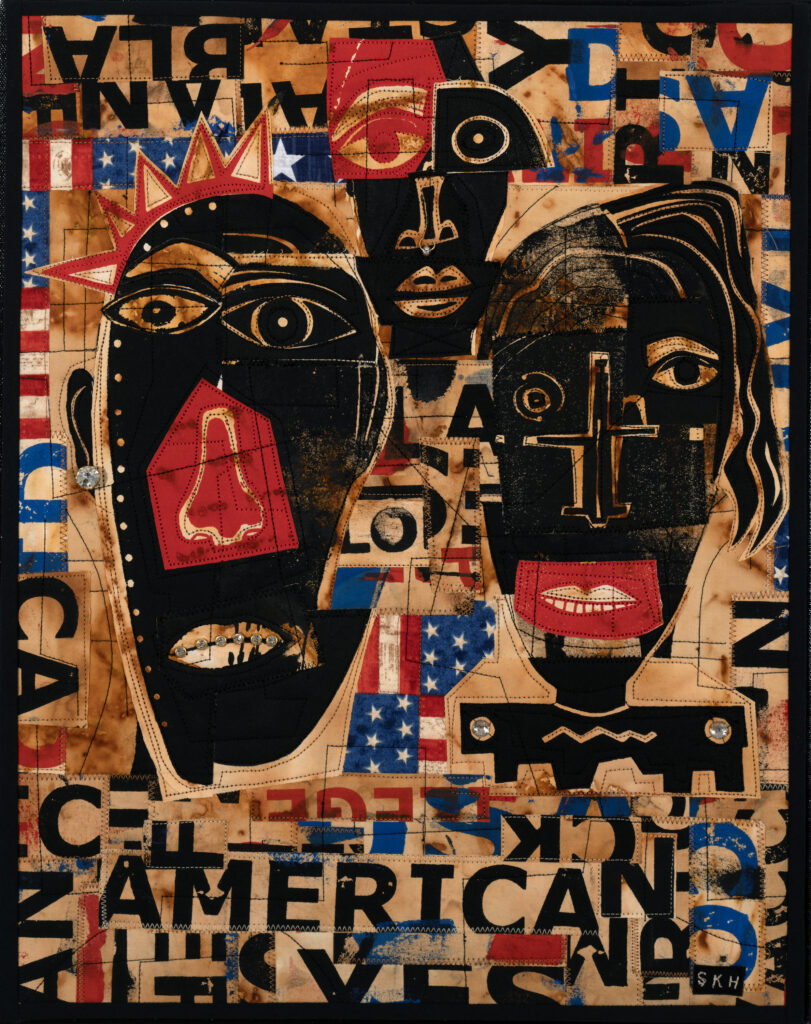
Sharon Kerry-Harlan; African American Gothic; 2025; acrylic paint, silk screens, rusted fabric, found objects, black canvas-wrapped wood frame; painted, screen printed, frame mounted; 20 x 16 in.
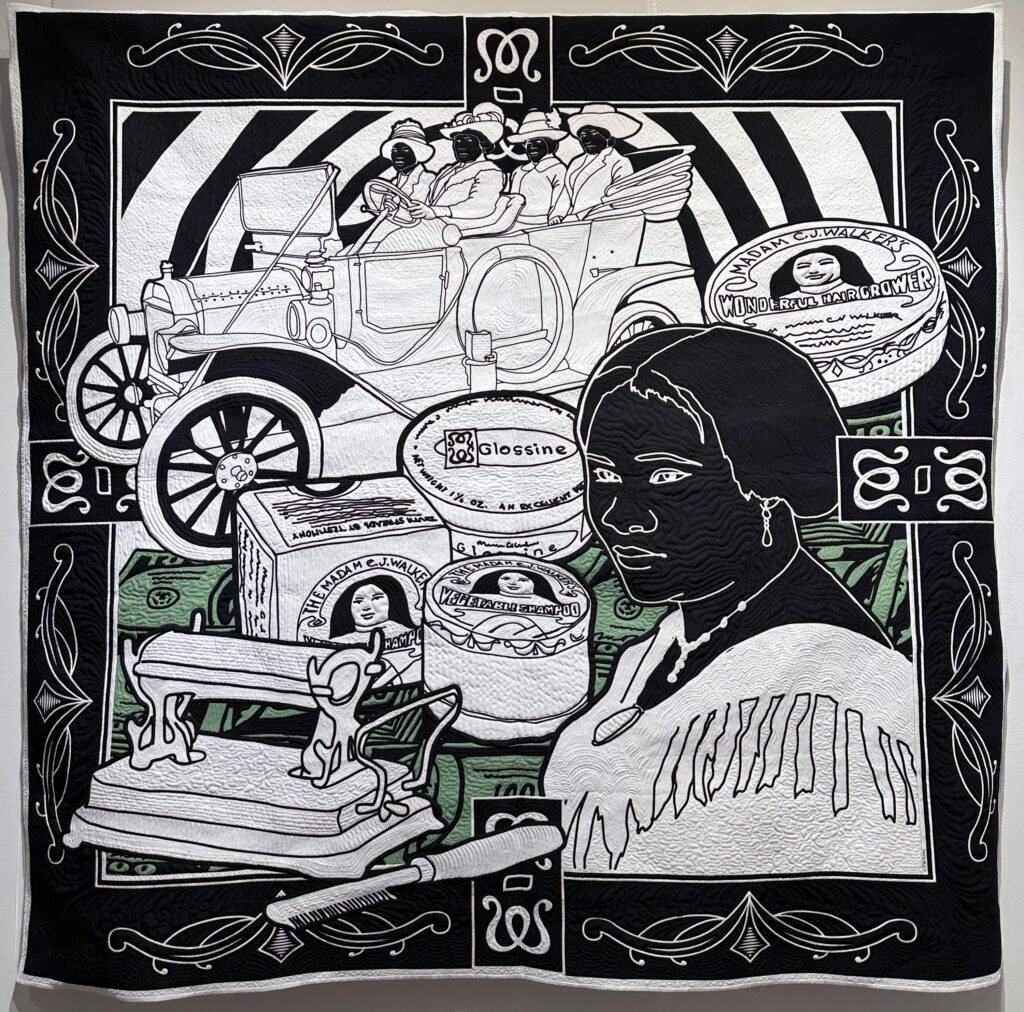
Carolyn Mazloomi; Madame C.J. Walker; 2025; cotton fabric, cotton batting, poly-cotton thread, India ink; printed, stenciled, hand painted, machine quilted; 76 x 77.5 in.
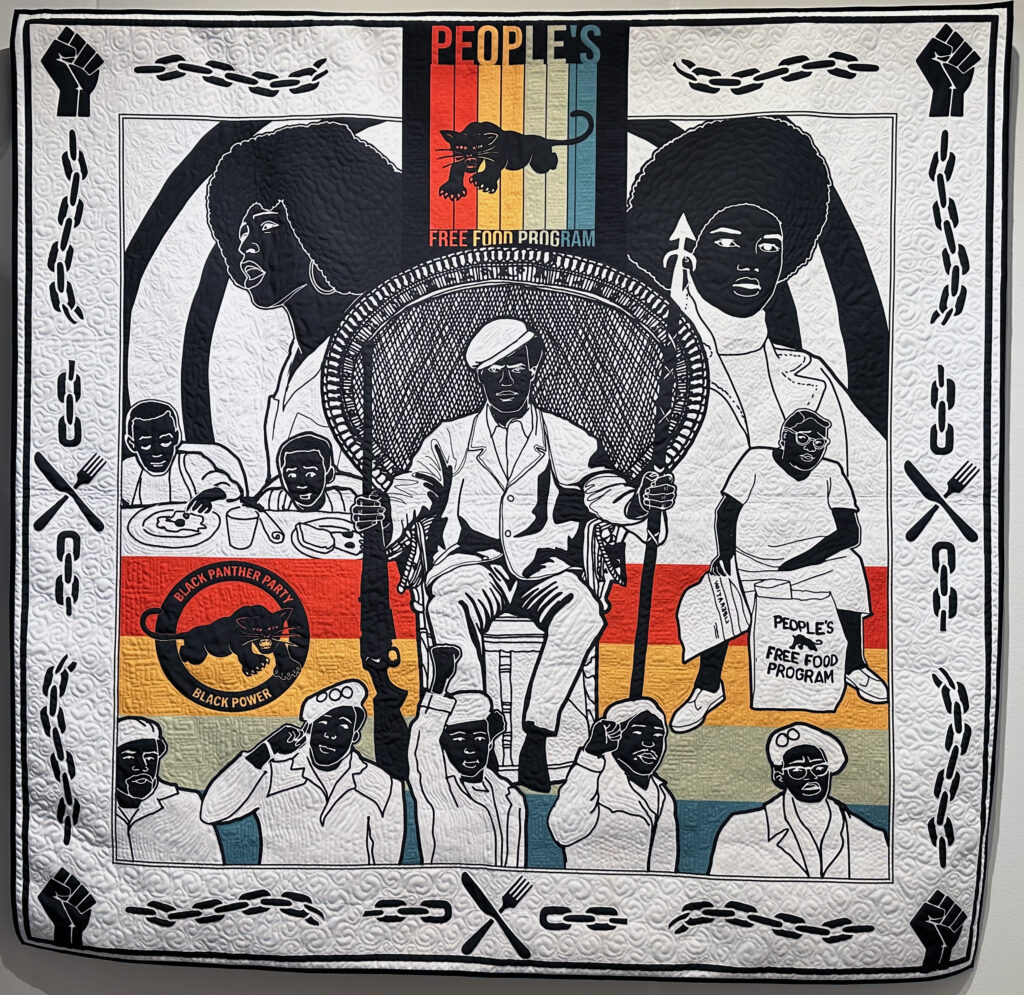
Although their visual languages are distinct, both artists approach textile and quilt making as acts of storytelling rather than traditional “craft.” Their works do not invent narratives; they carry forward lived histories, ancestral knowledge, and cultural memory embedded in cloth. Mazloomi’s figurative quilts are rooted in documented history, making visible the lives and contributions of Black Americans too often excluded from dominant narratives. Her stitched figures function as testimony—clear, intentional, and grounded in research and lived experience.
Kerry-Harlan’s work engages similar concerns through abstraction, process, and material transformation. Memory, for her, is not illustrated but embedded. She and her family have spent years documenting their lineage—compiling histories into a book and creating a detailed family tree that often finds its way directly into her quilts.
Handwritten names branch across white fabric, layered inside the work itself. Some may never be visible to the viewer, yet they remain present, held within the cloth like a time capsule, ensuring ancestors are remembered beyond time.
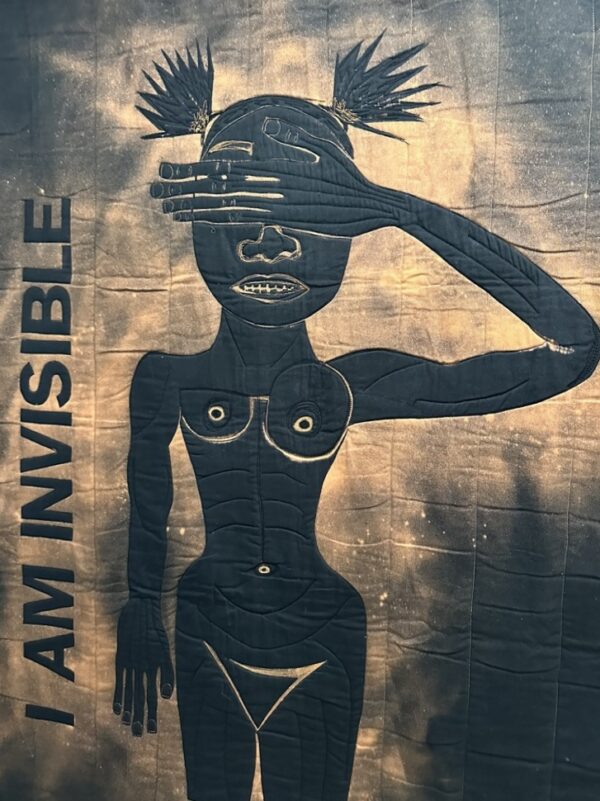
Sharon Kerry-Harlan; I Am Invisible; 2023; cotton fabric, thread, cotton batting; dye discharge, quilted; 50 x 45 in.
Material choices further reinforce this responsibility to history. Kerry-Harlan works with textiles that already carry meaning: vintage lace from her grandmother’s dress, an antique quilt made by an unknown relative, fabrics depicting Black women picking cotton. These elements are not decorative; they are witnesses. Together, her abstractions and Mazloomi’s figurative narratives demonstrate that storytelling in fiber can be both explicit and implied—equally truthful, equally powerful.
Carolyn Mazloomi; Black Panther Party; 2025; cotton fabric, cotton batting, poly-cotton thread, India ink; printed, stenciled, hand painted, machine quilted; 80 x 81 in.
Carolyn Mazloomi; Black Panther Party; 2025; cotton fabric, cotton batting, poly-cotton thread, India ink; printed, stenciled, hand painted, machine quilted; 80 x 81 in.
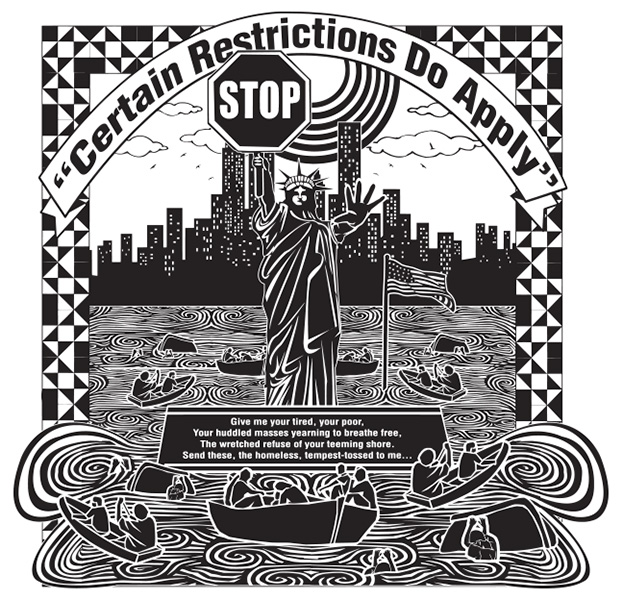
Carolyn Mazloomi; Certain Restrictions Do Apply; 2025; cotton fabric, cotton batting, poly-cotton thread, Inda ink; stenciled, hand painted, machine quilted; 75 x 78 in.
While their techniques differ—rust-dyed surfaces and evolving pattern systems alongside historically grounded figuration—the exhibition resists visual uniformity. Instead, it embraces dialogue. The works move viewers between felt history and seen history, between implied memory and declared story, honoring ancestry through both abstraction and representation.
Presented in Central Harlem, the exhibition sits within a gallery long committed to challenging the historical hierarchies of traditional art. Here, quilts are recognized not as domestic artifacts, but as intellectually rigorous and culturally consequential works. Certain Restrictions Do Apply asks viewers to slow down, look closely, and consider whose stories have been preserved—and whose have been constrained—across generations.
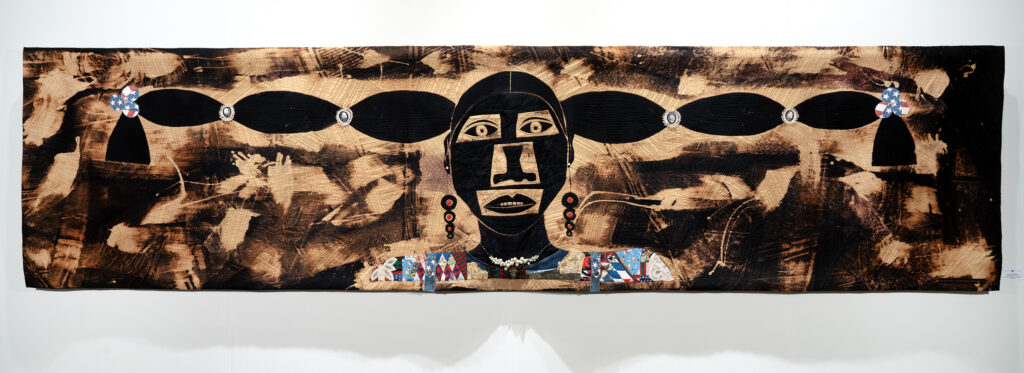
Sharon Kerry-Harlan; The Empire Builder; 2025; curated fabrics; dye discharge, quilted, embellished; 36.5 x 163.75 in.
Top image: Sharon Kerry-Harlan: Fragments of the Past, Threads of Memory; 2025; thread, found objects, textiles; quilted; 26 x 52 in.