Ojjas, Dabu, And the Power of Craft — Rajasthan Journey
Cami Smith
| Events
This is the first of two articles drawn from an extraordinary two-week creative textile journey through Rajasthan, India, that was dedicated to learning from generations of textile design, hand block printing, and natural dye traditions. It focuses on dabu printing in the village of Bagru and on Ojjas, a hand block- printing studio devoted to sustaining traditional craft through thoughtful, contemporary practice.
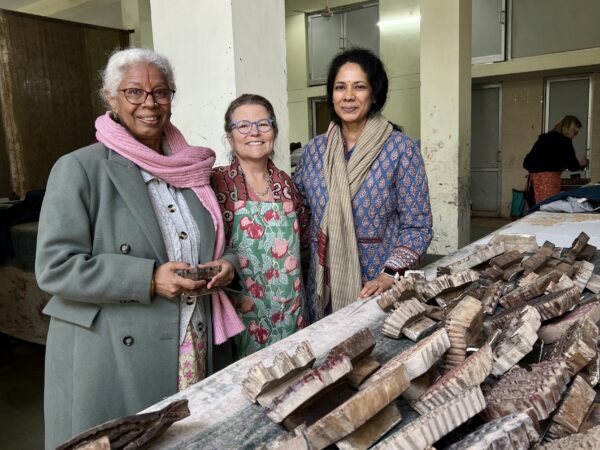
Raj Kanwar, Katrina Ulrich, and Namrata Singh with wood printing blocks. Photo credit: Jennifer Jones.
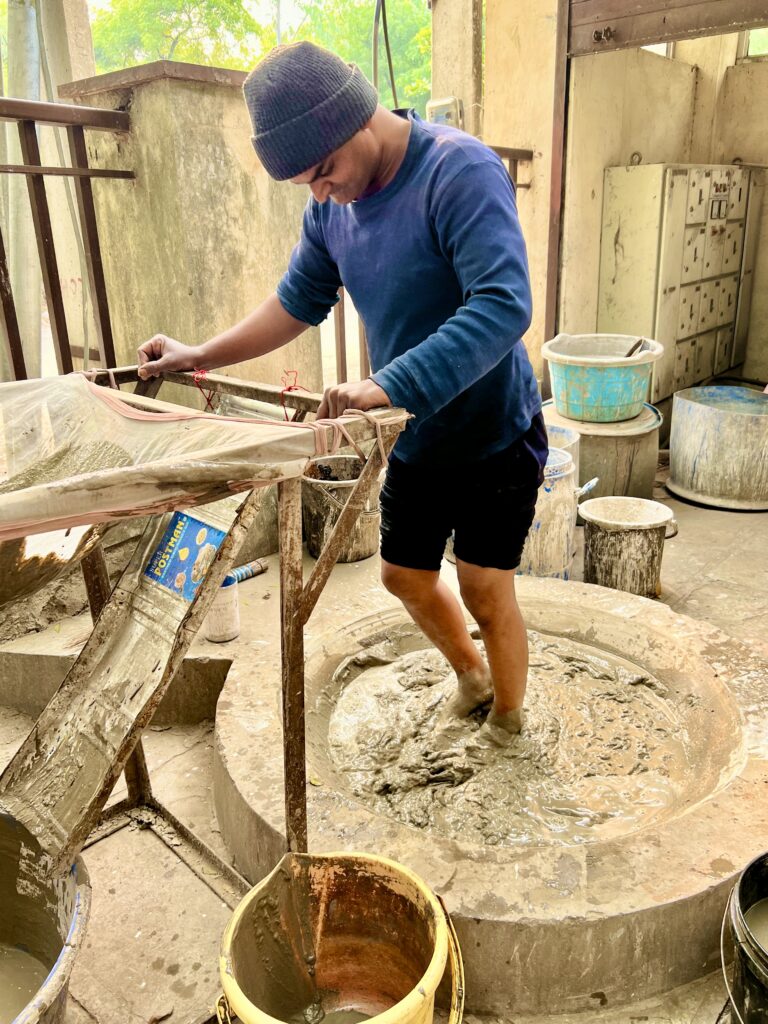
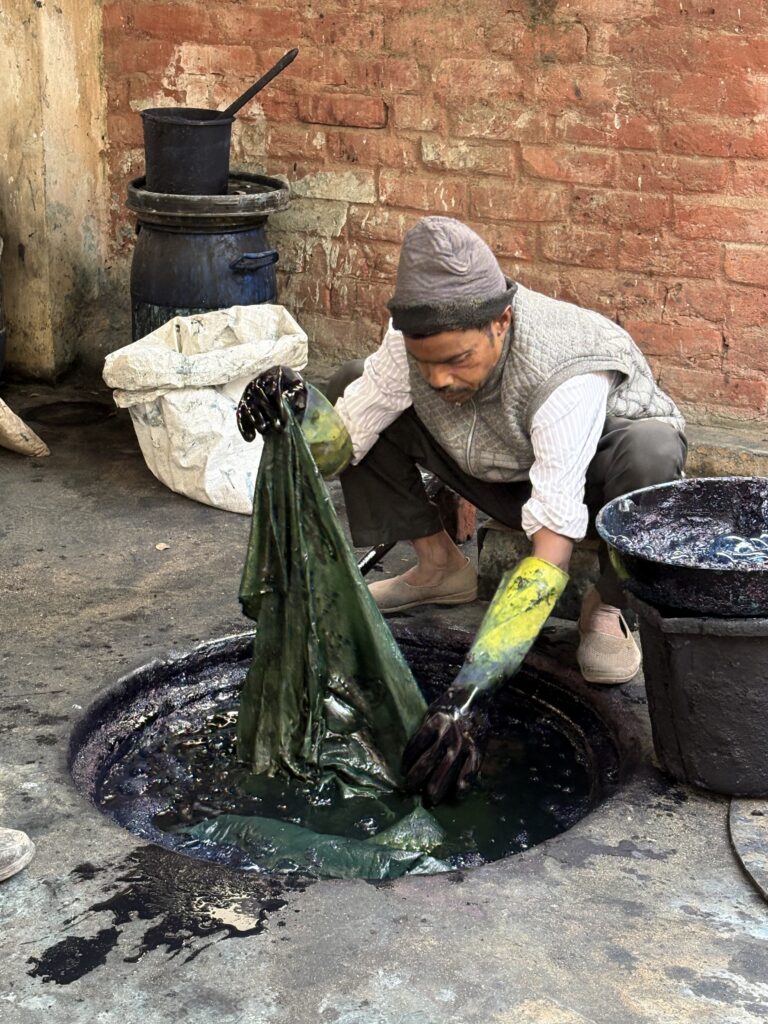
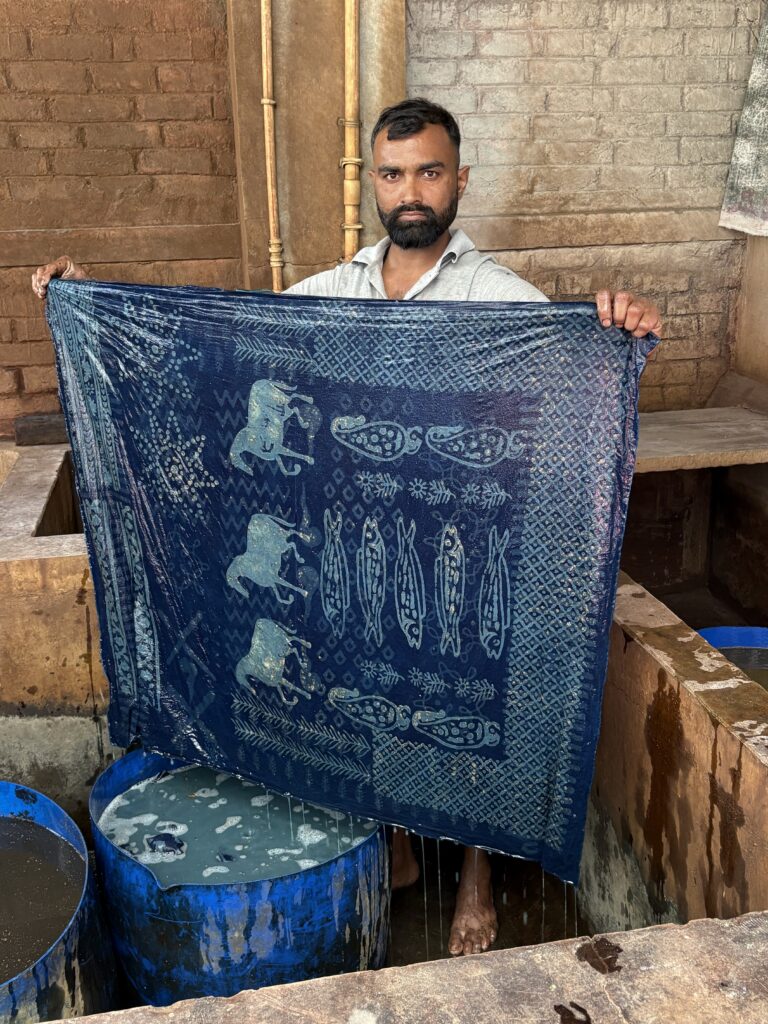
Each morning, we traveled from Jaipur to Bagru, a town renowned for its centuries-old hand block-printing traditions using natural dyes. Bagru is especially known for dabu—the mud-resist technique in which a paste of clay, lime, and natural binders is printed by hand onto white fabric, sprinkled with sawdust, and allowed to dry in the sun. It’s then dyed, often with indigo. When the cloth is washed, the resist falls away, revealing pattern, shadow, and surprise. It is a process that demands patience and timing, qualities that cannot be rushed.
Our two-day workshop took place at Ojjas, a hand block-printing and garment production unit founded in 1997 by Raj Kanwar. A designer and educator, Kanwar spent decades working in textile crafts before stepping fully into her own practice. Leaving a well-established government position was a deliberate risk.
Mixing the mud paste. Photo credit: Jennifer Jones
Ojjas craftsman with indigo bath. Photo credit: Cami Smith.
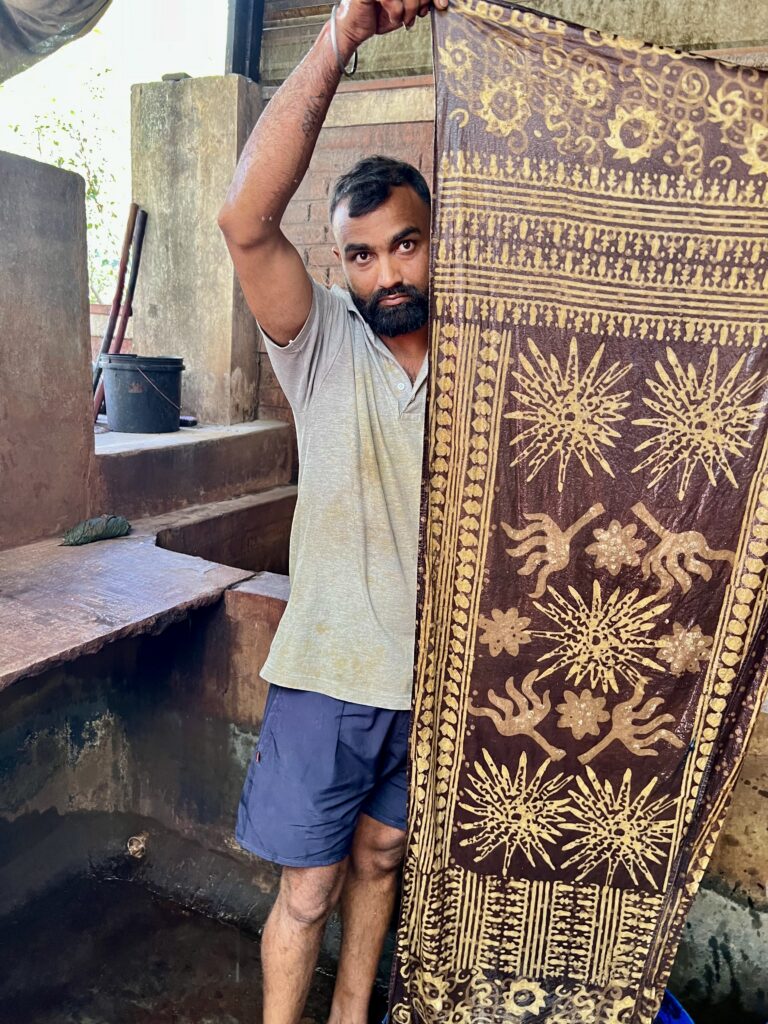
Ojjas craftsman holding up one of the rinsed fabrics. Photo credit: Lisa Schroeder.
“The risk was leaving a well-paid and satisfying position with great scope for growth,” Kanwar explained. “But my love for this craft—the play of design and color, and the endless possibilities within the same set of blocks—was impossible to ignore. I wanted to make a difference.”
That conviction is visible throughout Ojjas. Here, tradition is not preserved by holding it still, but by allowing it to respond to new contexts and contemporary design without losing its integrity.
Ojjas is deeply committed to social and ecological responsibility. It operates within Jaipur Bloc, an environmentally conscious textile park in the Bagru Industrial Area, where water—the primary resource in printing and dyeing—is recycled through a common effluent treatment system. Solar energy, water harvesting, tree planting, and thoughtfully designed infrastructure are embedded in daily practice. Equally central is the care given to the people behind the work: Artisans labor in well-ventilated spaces with ergonomically designed workstations, job rotation, employee benefits, and fair wages.
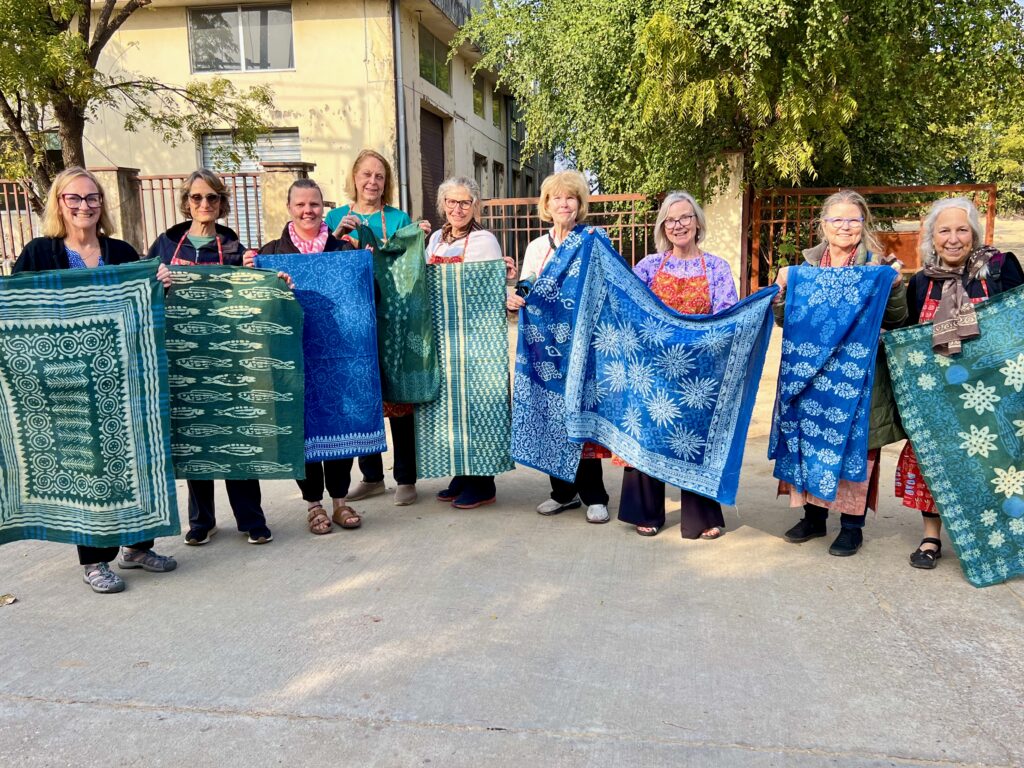
Showing final projects L-R: Patti Baymiller, Lisa Schroeder, Amanda Dorendorf, Kandace Heck, Ami Hooker, Constance Paske, Jennifer Jones, Katrina Ulrich, and Cami Smith. Photo credit: Namrata Singh.
For Kanwar, sustainability was never an add-on. “Crafts are a way of life and need to be nurtured,” she said. “Hand block printing is minimalistic in approach and fulfills the three pillars of sustainability—economic, social, and environmental.”
Watching the process unfold—from block carving and printing to dye mixing, washing, and finishing—reveals how many hands and forms of knowledge are involved in each piece of cloth. A finished garment may appear effortless, but it carries the imprint of many people working together, each responsible for a particular stage.
“The most striking part of this craft is communities working together with different skill sets,” Kanwar reflected. “Each garment passes through many hands, and with that comes a deep sense of responsibility to achieve one’s best.”
Ojjas craftsman showing fabric that was dyed with turmeric. Photo credit: Jennifer Jones
Kanwar speaks candidly about the challenges facing handcraft traditions today. Consumerism, speed, and constantly shifting fashion cycles have created what she described as a crisis—one in which the journey of a garment, the conditions of its making, and its environmental cost are rarely considered. Ethical practice and fair trade, she insisted, must guide our choices if these centuries-old traditions, and the communities they sustain, are to survive.
Ojjas also embodies continuity across generations. Kanwar’s daughter, Namrata Singh, trained as a designer alongside her mother and has spent more than two decades working in the handcraft sector, particularly supporting women in village communities through embroidery and garment training. She has expanded the work through Ojjas Textile Crafts—an offshoot that includes a garmenting unit, an online presence, and a retail space in Jaipur—while carrying forward the same values of sustainability, education, and care.
The name Ojjas comes from Sanskrit and is often translated as inner light or bountiful energy. “Ojjas means inner light—the essence of true creativity,” said Kanwar. “It is a vital life force … that is exactly where art begins.”