During my recent trip to India, I had the opportunity to witness several traditional craft practices up close. Last month, we shared my visit to a dabu block-printing workshop. This time, I’d like to take you inside another remarkable process: making handmade paper.
As fiber artists, we pay close attention to the surface—how a material is made and what that process leaves behind. During our visit to Jaipur, I toured Kalpana Handmade Paper Industries in nearby Sanganer, where the entire life of a sheet of paper unfolds visibly, from recycled cotton cloth to pulp to sun-drying racks. It was a powerful reminder of how deeply process shapes material.
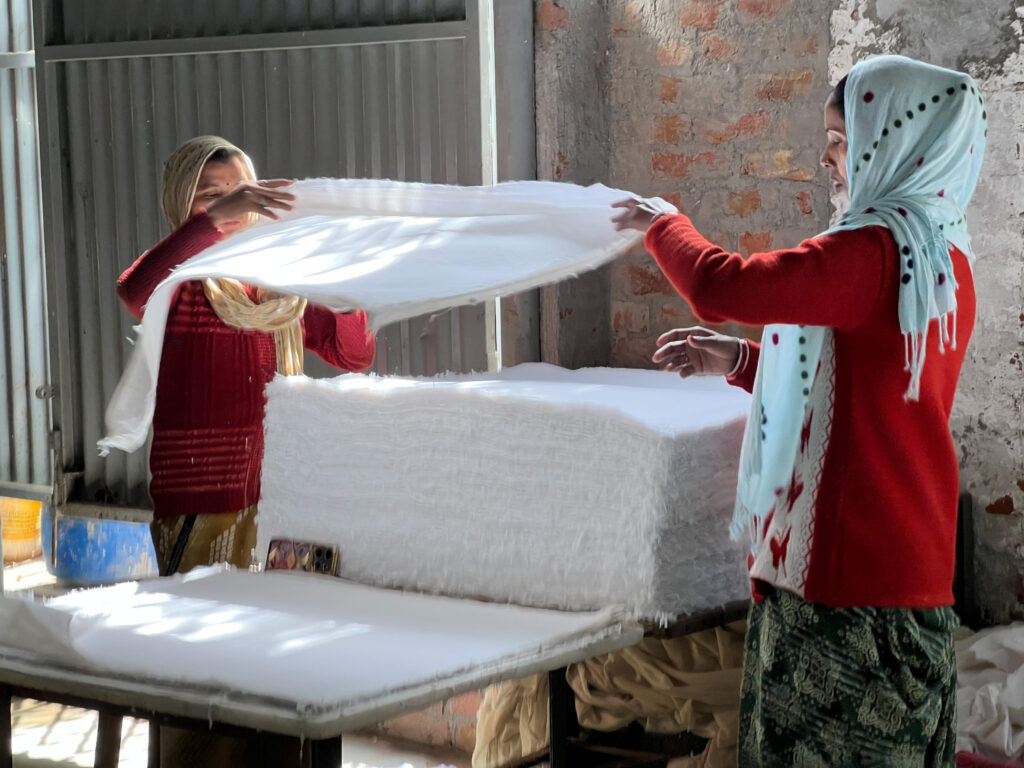
Two workers lay a freshly formed wet sheet onto the stack—a two-person job requiring care and coordination. Photo credit: Jennifer Jones
Sanganer, just outside Jaipur’s Pink City, is known globally for its traditional arts and crafts. In 1994, Ram Prasad Saini founded Kalpana Handmade Paper Industries with a clear vision: to preserve the art of handmade papermaking while creating a sustainable livelihood for local artisans. What began under open sky with five artisans working from recycled cotton waste has grown into three manufacturing units employing nearly 100 men and women, all without losing its ethical core.
Walking through the factory, the process of papermaking unfolds slowly and deliberately. Industrial and agricultural waste—cotton rags, plant fibers, and discarded materials—are transformed into richly textured sheets that feel alive in the hand.
The vats of pulp, the rhythmic lifting of screens, the pressing and drying in the sun, each step leaves a visible trace. For those of us drawn to handmade surfaces, it becomes clear that this paper carries the imprint of every stage—pulp, press, sun, and hand—each sheet holding evidence of its making.
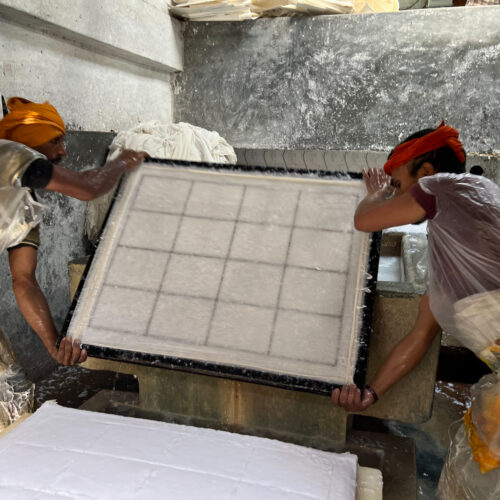
Lifting the heavy wet mold from the pulp vat, each grid will become an individual sheet of handmade paper. Photo credit: Jennifer Jones
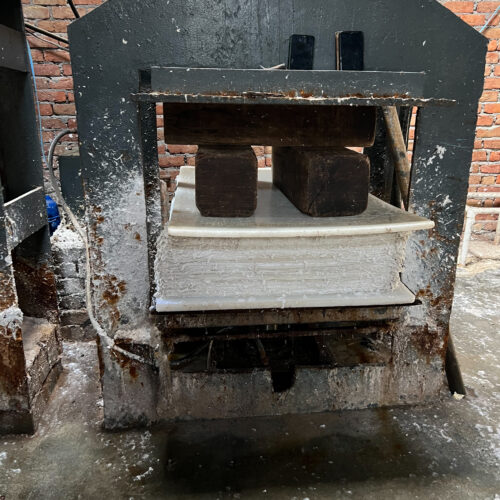
One of the big paper presses at Kalpana. Heavy wooden blocks compress a stack of wet sheets forcing out the water before drying. Photo credit: Jennifer Jones
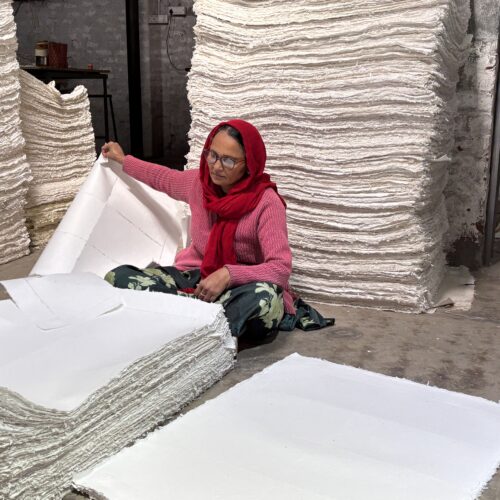
A worker inspects finished sheets on the mill floor, each one made by hand, one at a time. Photo credit: Cami Smith
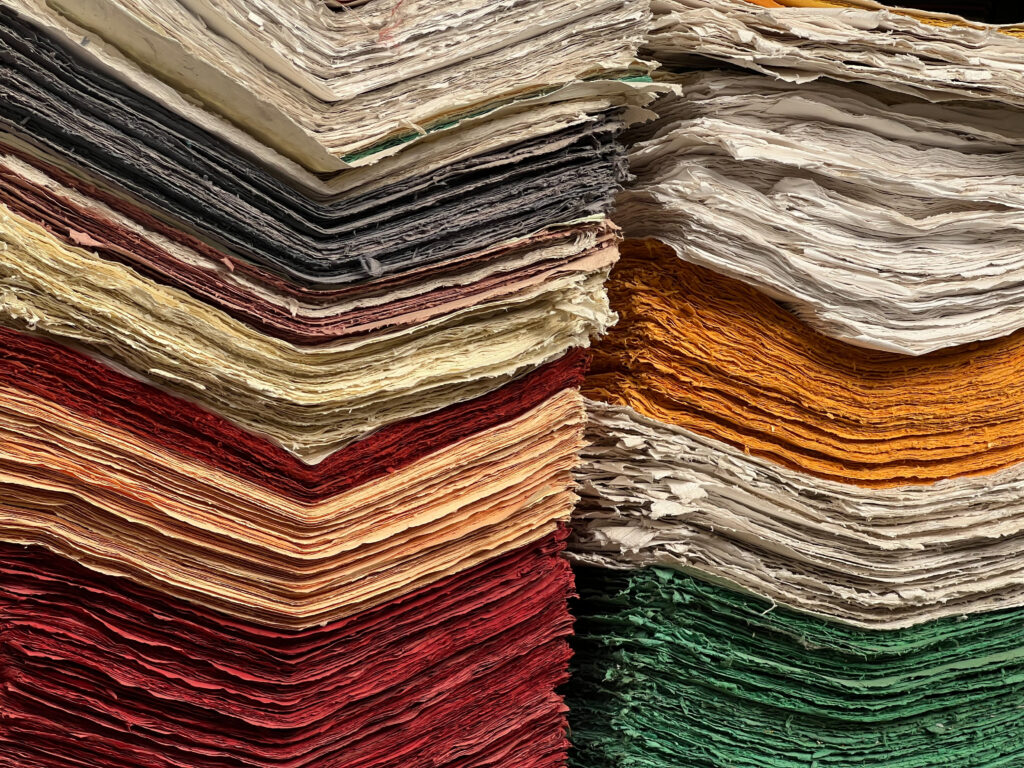
Kalpana now produces more than 400 varieties of paper, varying in texture, thickness, fiber content, and translucency. Some sheets are structural and dense; others are feather-light and luminous. Many incorporate visible plant matter, petals, or cotton fibers. Seeing the range of surfaces, I was struck by how naturally these sheets lend themselves to layering and stitching—their structure already holding depth before a mark is ever added.
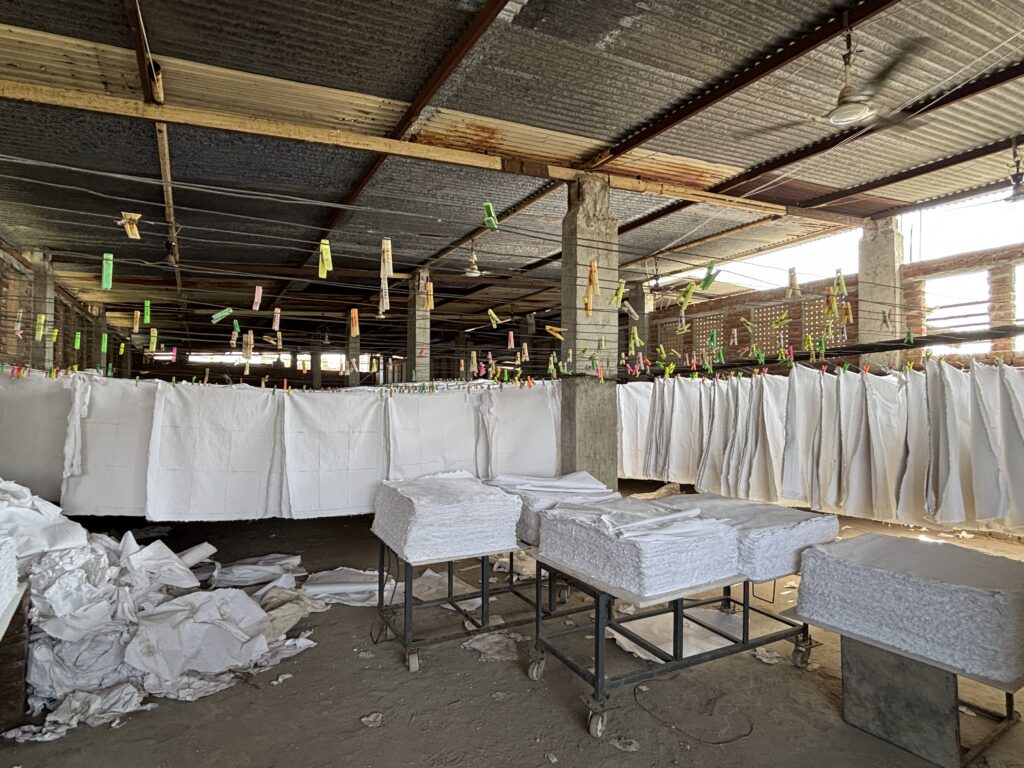
Sheets hang to dry across the full length of the mill; stacks of finished paper wait on carts below. Photo credit: Cami Smith
The scope of Kalpana’s impact extends beyond Jaipur. Through international collaborations, including a multi-year project in Uganda supported by the Norwegian government, the company has shared equipment, training, and eco-conscious methods to establish handmade papermaking operations abroad.
Walking through their buildings, it became clear this was not simply manufacturing but a craft sustained through time, discipline, and responsibility. Waste materials are redeemed through labor; water, fiber, and sunlight become collaborators in transformation. The paper reflects work that is visible rather than concealed—livelihoods are sustained through craft.
Stacks of dried, finished, cotton rag paper, each color made by hand, sheet by sheet. Photo credit: Jenifer Jones
Standing among stacks of finished sheets drying in the sun, I felt a deep respect for the labor behind them. Each sheet, shaped by water, hand, air, and time, carried the marks of repetition and care.